Structured Product Content

How Structured Product Content Improves Revenue

Most ecommerce brands try to grow revenue by:

  • Increasing ad spend
  • Running discounts
  • Redesigning the homepage

Very few optimize the structure of their product content.

Yet product pages are where revenue is decided.

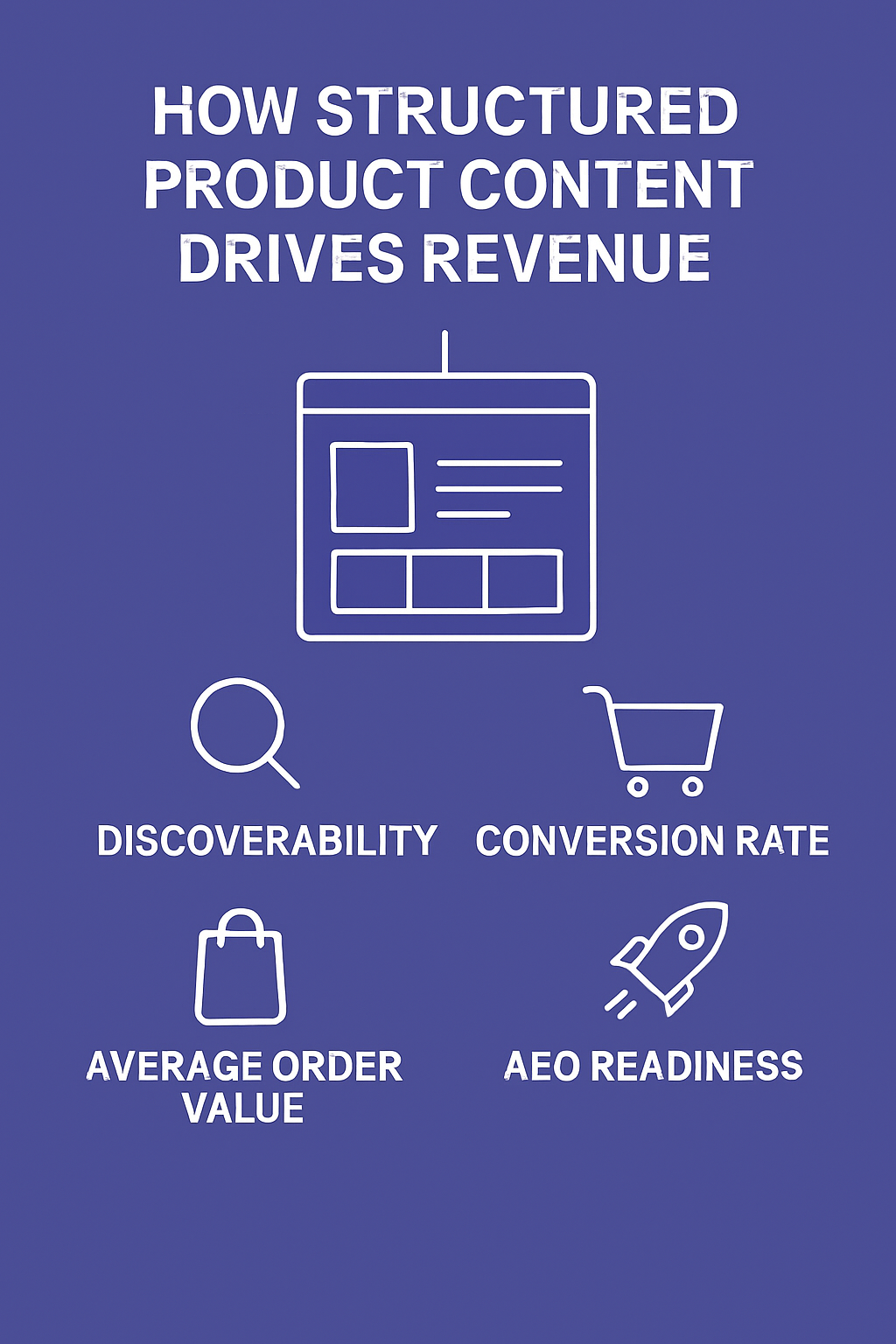
Structured content improves three measurable levers:

  • Discoverability
  • Conversion rate
  • Average Order Value
  • AEO readiness
Get Started Free
Structured Product Content Illustration

The Revenue Mechanism

Structured product content impacts performance through four core layers.

Discoverability (SEO)

When titles are structured and keyword-aligned:

  • Search engines understand relevance better
  • Category intent becomes clearer
  • Ranking consistency improves across SKUs
Better structure → Stronger indexing → Higher qualified traffic

AEO (Answer Engine Optimization)

Search behavior is changing. Buyers now search through:

  • AI assistants
  • Voice queries
  • Conversational search
  • Large language models

Structured product-aware Q&A increases the likelihood that:

  • Your content becomes answer-ready
  • Your product information appears in AI-generated responses
  • Your brand is surfaced during intent-based queries
Structured content → AI-readable context → Higher AEO visibility

SEO brings traffic. AEO brings intent.

Conversion Clarity

When product information is structured:

  • Buyers scan faster
  • Technical attributes are easier to process
  • Differences between similar products become clearer
Clearer information → Lower cognitive load → Higher add-to-cart rate

Even small improvements in conversion create meaningful revenue impact.

Buyer Confidence & AOV Support

Structured clarity also improves:

  • Trust
  • Perceived product value
  • Understanding of feature differences
  • Confidence in premium variants

When buyers understand value, they accept price. That supports:

  • Higher conversion rate
  • Higher Average Order Value (₹500–₹700 baseline for many catalogs)

What This Means in Practical Terms

Assume:
Monthly product page visits: 50,000
Conversion rate: 2.0%
Average Order Value: ₹600

Revenue = 50,000 × 2.0% × ₹600 = ₹600,000

Now assume structured clarity improves conversion from 2.0% to 2.3%. The revenue difference is meaningful - even before accounting for AOV improvements.

The key insight:
You do not need dramatic change. You need structured consistency across the catalog.

At scale, small improvements compound.

This Is Not About Writing More

Revenue improvement does not come from longer descriptions.

It comes from:

  • Attribute-backed structure
  • Intent-aware Q&A
  • SEO-aligned titles
  • AI-readable formatting
  • Governed tone consistency

Structure reduces friction.
Friction reduces conversion.

See Structured Content In Action

Understanding the mechanism is one step.

Seeing structured enrichment applied to real products is the next.